


Dr. Stephanie Susberich (DMA, Composition, University of Missouri–Kansas City, 2025) is a first-generation American composer and vocalist whose work inhabits the space where story, resonance, ritual, and historical memory converge. Her compositional practice is particularly concerned with the recovery of women’s voices from the archive, returning words obscured or nearly lost to history to living sound. She is the founder and artistic director of DVSSIMA, a New York–based creative house and salon series devoted to intimate, immersive musical experiences shaped by elegance, interiority, and form.
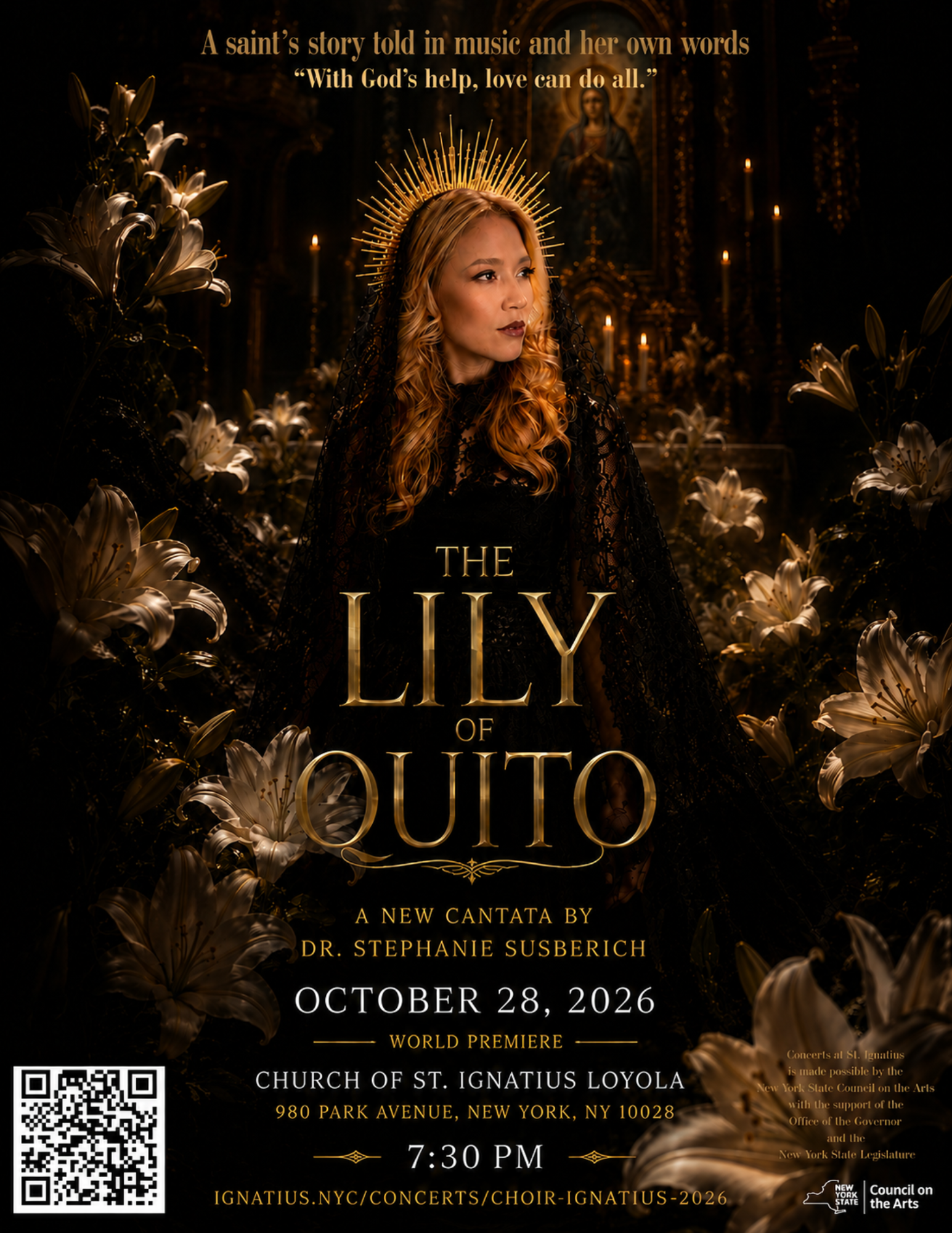
Her doctoral dissertation composition, The Lily of Quito, a 40-minute cantata setting the original words of Saint Mariana de Jesús de Paredes, will receive its New York premiere on October 28, 2026, at the Church of St. Ignatius Loyola on Park Avenue, with Dr. Susberich performing the title role. Drawing directly upon the saint’s own words, the cantata centers the life and writings of the patroness of Ecuador, tracing a devotional arc through sacrifice, beauty, death, and transcendence, and culminating in a vision of the saint’s passage into eternity. The Lily of Quito has also been included in the musical archives of Joaquín Rodrigo in Madrid due to its quotation of a melody from Rodrigo’s aria La despedida de Azucena, drawn from his unfinished oratorio La Azucena de Quito, which concerns the same saint.
Her music has been premiered by ensembles and organizations including Uptown Camerata, Composers Concordance, the Etchings Festival, International Contemporary Ensemble, and Radius Ensemble. Composer Anna Clyne has praised Susberich’s “intuition for form and counterpoint/harmony,” her creation of “really beautiful sonorities,” and her “great use of space,” singling out Aphrodite for flute and oboe and her work for the International Contemporary Ensemble, a cloak, a cluster, a casing, for harp, flute, and guitar.
As a vocalist, Susberich brings her operatic background into close relationship with her work as a composer. Lisa Kao, a former member of the Liederkranz Foundation, has described Susberich’s music as “nothing short of breathtaking,” praising the way she “seamlessly blends the elegance of opera with a modern touch” to create a sound that is “both timeless and deeply moving.” Susberich has appeared as a performer in venues ranging from Los Angeles’s Viper Room to NJPAC, and throughout New York City at Joe’s Pub, Dixon Place, the cell theatre, Cornelia Street Café, NYU’s Kimmel Center, Pangea, and Old St. Patrick’s Basilica, as well as at Kansas City’s Cathedral of the Immaculate Conception and the University of Missouri–Kansas City’s White Hall and Grant Hall.
On March 8, 2026, International Women’s Day, she presented a sold-out performance of her song cycle Songs of Juana Borrero at the cell theatre in Chelsea as part of Carnegie Hall’s city-wide United in Sound: America at 250 Festival, in a program presented by the Cuban Cultural Center marking the 130th anniversary of Borrero’s death. The recording of the cycle was released as Susberich’s debut album, Songs of Juana Borrero, on Composers Concordance Records, with cover artwork by Cuban painter Héctor Frank.
The cycle originated as Susberich’s master’s thesis at Tufts University (2022), setting the poetry of the nearly forgotten Cuban poet Juana Borrero, who died in political exile in Key West at the age of eighteen while her country fought for independence. Borrero’s brief life was marked by extraordinary artistic intensity, devotion, and visionary inwardness. Her work exemplifies a central current in Susberich’s artistic practice: an engagement with the archive as a site of recovery, particularly of women’s voices that have been obscured, neglected, or nearly lost to history. By returning Borrero’s words to living sound, Susberich’s work moves beyond commemoration toward a form of artistic restoration, allowing a voice separated from contemporary audiences by more than a century to speak again through music. Susberich’s commitment to recovering neglected voices has also been recognized by composer Jake Heggie, who, following a master class during her doctoral studies, told her, “The work you’re doing is important.”
While completing her doctorate, Dr. Susberich served for three semesters as a Graduate Teaching Assistant in the UMKC Composition Department, teaching laboratories in instrumentation, notation, and twentieth-century counterpoint, and offering private composition instruction to undergraduate composers. She earned a High Pass on her DMA comprehensive examinations and maintained a 4.0 GPA throughout her doctoral studies.
Susberich is also a survivor of severe systemic lupus erythematosus, an illness that profoundly interrupted her life in early adulthood. In her early twenties, she spent two years bedridden in the hospital and ultimately approximately five years of her life bedridden by illness, enduring extraordinary and prolonged physical pain. Her disease became life-threatening and attacked multiple systems of her body. A spinal lesion caused partial paralysis and placed her at risk of permanent paraplegia; she underwent chemotherapy in an effort to shrink the lesion and ultimately regained the function she had lost.
Her illness also required major cardiothoracic surgery on her lungs. Following her first operation, the port intended to deliver postoperative pain medication had not been connected to her body, and she awoke from deep thoracic surgery with no pain medication being administered. For approximately twenty-four uninterrupted hours, she endured the full postoperative pain of the surgery without pain medication, screaming continuously from the severity of the pain. The extreme physiological stress her body endured during those hours caused serious complications requiring emergency surgical intervention. When pain medication was finally administered, she was able to sleep only briefly before being awakened and taken back into surgery in an emergency effort to address the damage and complications that had followed the first operation. She thus endured two major cardiothoracic surgeries in immediate succession under extraordinary circumstances, an ordeal that compounded years of severe physical pain and debilitation from lupus itself and brought her life into still greater jeopardy.
During those years, with her future profoundly uncertain, Susberich searched for the story of someone who had been as gravely ill as she was and had survived, recovered, and gone on to build a full and meaningful life. She found no one. In the absence of the example she desperately needed, she made a promise to God: if she survived and regained her life, she would one day speak openly about what she had endured, so that another person facing catastrophic illness might find in her story what she herself had searched for and could not find: living evidence that survival, recovery, and a flourishing life beyond illness are possible.
More than a decade later, recovered and building a life as a composer, vocalist, and artist, Susberich now shares this history publicly in fulfillment of that promise. She does so not to allow illness to define her, but because the life she has built beyond it is itself part of what she once needed to know was possible. She hopes that someone searching from a hospital bed, frightened by the severity of what is happening to their body and uncertain whether a future remains available to them, might encounter her story and find reason to believe that profound illness need not be the final chapter of a life.
That history of survival stands in profound relationship to Susberich’s artistic life. Her preoccupation with mortality, embodiment, devotion, memory, and transcendence is not solely aesthetic or intellectual: it emerges, in large part, from having encountered the extremity and vulnerability of life itself at an age when she did not know whether she would survive to have a future. Having endured years in which pain, physical incapacity, and the possibility of death radically altered the dimensions of her world, she approaches the act of making art with an acute consciousness of both the fragility and the preciousness of embodied life. The recovery that recurs throughout her work therefore carries more than one meaning: the recovery of voices from historical silence, the recovery of memory through sound, and, beneath them, the lived knowledge of what it is to lose nearly everything one understood as a life and nevertheless return to it.
Across composition, performance, and curatorial practice, Dr. Susberich approaches music as both a living art and a vessel of memory: a potent force through which voices may be recovered, histories revivified, and the sublime made intimate. Her aesthetic draws the sacred and the sensual into the same space, joining Gothic darkness with luminosity, formal restraint with luxuriant sonority, and devotional intensity with an embodied, deeply sensuous relationship to sound. These qualities do not function as opposites in her work, but exist simultaneously: beauty is at once disciplined and voluptuous, shadowed and radiant, spiritual and corporeal. For Susberich, these tensions are not abstractions. The body that sings is a body she once faced losing; breath itself carries the memory of lungs that once required repeated major surgery; mortality is something she encountered not at a philosophical distance, but as an immediate possibility; and transcendence belongs to a spiritual vocabulary forged, in part, during years when survival itself was uncertain.
Whether writing or singing, Susberich is drawn to the charged threshold where mortality, desire, devotion, and transcendence entwine. Her work inhabits that threshold with the knowledge that beauty does not require the absence of darkness, nor does suffering possess the final word. Through sound, she seeks what she once sought for herself: the possibility that what has been silenced may speak again, what has been obscured may be brought into light, and what has passed through the shadow of death may yet emerge into another life.
Compositions
by Stephanie Susberich
-
Dr. Stephanie Susberich
-
Dr. Stephanie Susberich
-
Dr. Stephanie Susberich
-
Dr. Stephanie Susberich
-
Dr. Stephanie Susberich
-
Dr. Stephanie Susberich
-
Dr. Stephanie Susberich
-
Dr. Stephanie Susberich
-
Dr. Stephanie Susberich